This post contains links to VPN providers. If you sign up through them we may earn a small commission, at no extra cost to you. Prices change frequently, so check the provider’s site for today’s figure.
A VPN encrypts your traffic and routes it through a server elsewhere, which hides your browsing from your internet provider and your IP address from the sites you visit. It is genuinely useful on public Wi-Fi, for keeping your provider out of your browsing history, and for reaching services while travelling. It is not anonymity, and it will not protect you from malware or from logging into an account that already knows who you are.
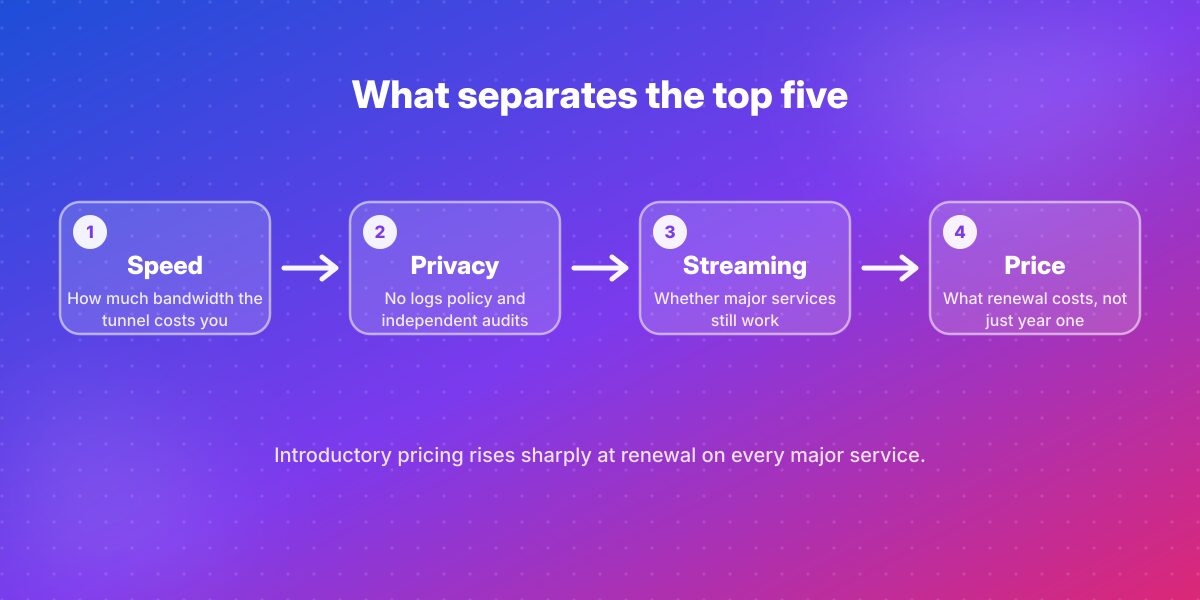
Five services stand out in 2026, based on independent testing by Tom’s Guide and similar outlets. One point before the list: every one of these advertises a low monthly figure that applies only to a multi-year plan paid upfront, and renewal pricing is substantially higher on all of them. Budget for the second year, not the first.
NordVPN
- Price
- From about $3.49/mo on a 2-year plan
- Devices
- 10
- Servers
- 9,000+ in 167 countries
- Best for
- Most people
Tom’s Guide ranks NordVPN its top pick for most people in 2026, and the reasoning is hard to argue with: consistently fast speeds through its NordLynx protocol, reliable access to streaming services, an independently audited no-logs policy, and a deep set of extra features including threat protection and a password manager. The apps are more complex than some rivals, split tunnelling is still missing on Mac, and renewal prices rise sharply after the introductory term. It is also one of the better options if you intend to put a VPN on your router.
Surfshark
- Price
- From about $2.49/mo on a 27-month plan
- Devices
- Unlimited
- Servers
- 4,500+ in 100 countries
- Best for
- Households and tight budgets
Surfshark is the cheapest of the major services and the only one here with no device limit, which makes it the obvious pick for a family or anyone with a drawer full of gadgets. Speeds are good, the apps are simpler than NordVPN’s, streaming access is dependable, and split tunnelling works on every platform. The trade-offs are fewer advanced features, weaker malware blocking than its marketing implies, and OpenVPN requiring manual setup. Renewal pricing climbs here too.
ExpressVPN
- Price
- From about $2.99/mo on a 2-year Basic plan
- Devices
- 10 to 14 depending on plan
- Servers
- 3,000+ in 113 countries
- Best for
- Beginners
ExpressVPN has built its reputation on simplicity, and the apps are near-identical across every platform, which matters if you are setting a VPN up for someone else. Windows speeds are strong thanks to its Lightway protocol, the privacy credentials are solid, and its written support articles are the best in the business. In exchange you get fewer customisation options, extra features that cost more on higher tiers, live chat support that reviewers say has slipped, and Lightway Turbo restricted to Windows.
Proton VPN
- Price
- From about $2.99/mo on a deal, more at standard rates
- Devices
- 10
- Servers
- 20,000+ in 148 countries
- Best for
- Anyone who takes privacy seriously
Proton VPN is the one to choose if privacy is the actual reason you are buying rather than a bullet point. The apps are open source and independently audited, Secure Core routes traffic through a second hardened server in a privacy-friendly jurisdiction before it leaves the network, and there is a genuinely usable free tier with no data cap. Top speeds are very high and streaming works well. The interface is more complex, the Mac app lags behind, live chat is not around the clock, and OpenVPN speeds trail the competition.
Norton VPN
- Price
- From about $2.49/mo on a 2-year Standard plan
- Devices
- 10 or 20 depending on plan
- Servers
- 3,400 in 102 countries
- Best for
- Unblocking streaming services
Norton’s VPN is the surprise of recent testing rounds: Tom’s Guide found it unblocked every streaming service it tried, which is more than can be said for several better-known rivals. The apps are straightforward, privacy provisions are sound and the price is competitive, particularly if you already pay Norton for security software. It is weaker elsewhere, with few customisation options, no Linux client, limited feature parity on Apple platforms and a Mac app reviewers found intrusive. Norton also limits installations rather than simultaneous connections, which is a different model to the others here.
Quick comparison
| Service | From | Devices | Countries | Best for |
|---|---|---|---|---|
| NordVPN | $3.49/mo | 10 | 167 | Most people |
| Surfshark | $2.49/mo | Unlimited | 100 | Value |
| ExpressVPN | $2.99/mo | 10–14 | 113 | Ease of use |
| Proton VPN | $2.99/mo | 10 | 148 | Privacy |
| Norton VPN | $2.49/mo | 10–20 | 102 | Streaming |
What actually matters when choosing
- Look at the renewal price. Every service here advertises a first-term rate. The second year typically costs two to three times as much.
- Check the audit, not the slogan. “No logs” means little without a recent independent audit. NordVPN, ExpressVPN and Proton all publish them.
- Count your devices honestly. If the household has more than ten things to cover, Surfshark’s unlimited allowance or a router installation saves money.
- Expect a speed cost. A good service on a nearby server loses perhaps ten to twenty per cent. Much more than that means the server is too far away or the protocol is wrong.
- Use the refund window. All five offer thirty days. Test streaming, speed and your own usual sites before the window closes.
Our verdict
For most people NordVPN is the right balance of speed, reliability and features. If the household has many devices or the budget is tight, Surfshark does nearly as much for less. If privacy is the genuine motivation, Proton VPN is the most credible choice, and its free tier lets you test the claim before paying anything.
FAQ
Are VPNs legal in the USA? Yes. Using one to commit a crime is not.
Will a VPN make me anonymous? No. It hides traffic from your provider and your IP from sites, but accounts you log into still identify you.
Are free VPNs safe? Mostly not. Running servers costs money, and services that do not charge often monetise your data instead. Proton VPN’s free tier is the notable exception.
Will a VPN slow my connection? Slightly, with a good service on a nearby server. Distance and protocol make the difference.
Does a no-logs policy mean anything? Only as far as it has been tested. Independent audits and, better still, court cases where a provider genuinely had nothing to hand over, carry far more weight than a claim on a marketing page.
Can a VPN unblock streaming libraries from other countries? Sometimes, and inconsistently. Streaming services actively detect and block VPN address ranges, so a server that works this month may not next month. Treat it as a bonus rather than a reason to subscribe.
Is WireGuard better than OpenVPN? For most people, yes. WireGuard is faster and connects more quickly. OpenVPN remains useful on restrictive networks because it is harder to identify and block.
Should I pay for a multi-year plan? The per-month cost is much lower, but you are committing to a company whose ownership and policies may change. A shorter plan first, to confirm the speeds and apps suit you, is a reasonable approach.
Do I still need antivirus if I use a VPN? Yes. A VPN encrypts the connection; it does not stop you downloading something harmful or entering details on a fake site. The bundled threat protection features are a useful extra, not a replacement.
How many devices can I usually connect at once? Most providers allow between five and ten simultaneous connections on one subscription, and a few place no limit at all. Running the VPN on your router counts as a single connection however many devices sit behind it.